
Settings
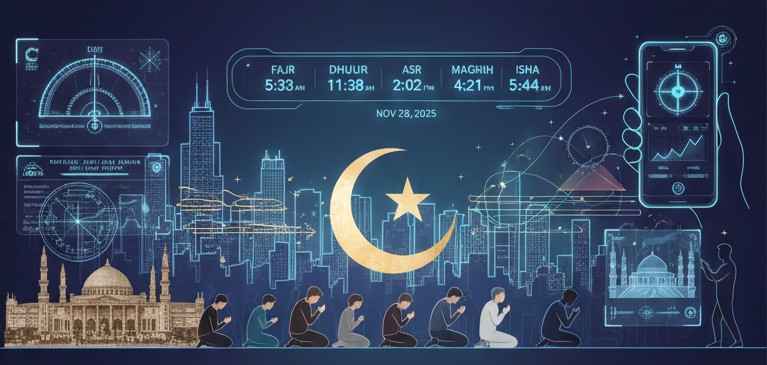
Prayer Times in Chicago – A Comprehensive Guide
This guide explores the history, methods, and modern applications of determining prayer times in Chicago, highlighting the spiritual and scientific aspects for the city’s diverse Muslim community.
Introduction: The Spiritual Rhythm of Chicago
- “Prayer times Chicago” refers to the precisely calculated moments for the five obligatory Muslim prayers (Salah): Fajr (dawn), Dhuhr (noon), Asr (afternoon), Maghrib (sunset), and Isha (night).
- These prayer times serve as spiritual anchors for Muslims in Chicago, connecting them to their faith amidst daily life.
- The guide aims to uncover the evolution of prayer time determination methods in Chicago, blending faith, science, and tradition.
Historical Context: Early Muslim Presence and Prayer Time Determination
- Early Presence: Muslims had an ephemeral presence in Chicago with temporary mosques at the 1893 World’s Columbian Exposition.
- Pioneering Institutions: Permanent community foundations were laid by Bosnian and Arab immigrants in the early 1900s. Key institutions include:
- Al-Sadiq Mosque (established 1922)
- Mosque Foundation (founded 1954)
- Traditional Methods: Before modern technology, prayer times were determined through direct observation of the sun’s trajectory, shadow lengths, and celestial movements by community leaders.
- Standardization: As Chicago’s Muslim population grew in the mid-20th century, the need for standardized prayer schedules increased. This led to the adoption of astronomical tables.
- Chicago Hilal Committee: Established over 40 years ago, this committee played a pivotal role in standardizing the Islamic calendar for the Chicagoland area, contributing to uniformity in prayer times.
Keep in mind that we calculate the prayer times in Chicago according to most famous calculation methods worldwide.
Modern Prayer Time Calculation: Science and Spirit
- Core Principle: Modern prayer time calculations are intrinsically linked to the sun’s movements.
- Geographic Factors: Calculations meticulously factor in Chicago’s specific geographic coordinates:
- Latitude (influences daylight duration)
- Longitude
- Altitude above sea level
- Methodological Variations: Different calculation methodologies exist, with prominent examples including:
- ISNA (Islamic Society of North America)
- MWL (Muslim World League)
- Key Differences: The primary distinctions lie in the angles used for calculating Fajr (dawn) and Isha (night) prayer times.
- Asr Prayer Nuance: The Asr prayer calculation varies based on different schools of Islamic jurisprudence:
- Hanafi school: Uses a different standard for shadow length.
- Shafi’i, Maliki, and Hanbali schools: Use a different standard for shadow length.
- Spiritual Significance: Prayer times are a fundamental pillar of Islam, fostering a direct connection to the Divine, discipline, spiritual cleansing, moral guidance, and community unity.
- Chicago’s Muslim Community:
- Estimated population: 350,000 to 500,000 individuals. and you will see that most of them searching prayer times in chicago
- Diversity: One of the most diverse Muslim communities in the U.S., with enclaves like “Little Palestine” in the south suburbs and communities on the North Side.
- Mosque Functions: Mosques serve as vital community hubs, offering social, educational, and spiritual services.
- Key Institutions: Muslim Community Center (MCC), Mosque Foundation, Downtown Islamic Center (DIC).
Navigating Variations in Prayer Times
- Sources of Difference: Variations in prayer times across Chicago stem from:
- Calculation Methods: Different methodologies (ISNA, MWL, etc.) yield slightly different results, particularly for Fajr and Isha.
- Juristic Preferences: Differences in shadow length calculations for Asr prayer.
- Seasonal Changes: Chicago’s distinct seasons and daylight saving time necessitate dynamic adjustments.
- Resolution: Individuals and mosques choose their preferred calculation method. Alignment with a local community or trusted source is recommended.
Technological Advancements in Prayer Time Determination
- Ubiquitous Apps: Smartphones with apps like Muslim Pro and Athan provide location-based accuracy, customizable methods, and audible Adhan notifications.
- AI and Machine Learning (ML):
- Dynamic Adjustments: AI is used to dynamically adjust prayer times for travelers, especially on polar flights, accounting for time zones and daylight savings in real-time.
- Enhanced Precision: AI is expected to refine Fajr and Isha calculations by analyzing subtle changes in sky light.
- Wearable Technology: Smartwatches offer prayer alerts and Qibla direction.
- Immersive Technologies: Augmented Reality (AR) and Mixed Reality (MR) are emerging for:
- Visualizing Qibla direction.
- Creating immersive virtual mosque environments.
- Teaching prayer rituals through 3D animations.
- Comprehensive Islamic Ecosystems: Apps are evolving to include:
- Quran and Hadith access.
- Duas and Tasbih counters.
- Halal food finders.
- Community event listings.
- Goal: To make prayer more accessible, engaging, and seamlessly integrated into modern life, helping Chicagoans maintain a strong spiritual grounding. check this website on daily basis for prayer times in Chicago is going you near to the Almighty Allah
Enduring Faith, Embracing Innovation
The evolution of “prayer times Chicago” from direct observation to AI-powered apps demonstrates a community dedicated to its faith while embracing innovation.
Despite technological advancements, the spiritual essence of Salah remains constant: a direct connection to the Divine, a reminder of purpose, and a source of inner peace.
The enduring rhythm of prayer enriches Chicago’s vibrant and diverse tapestry, whether accessed through apps, the Adhan, or observation of the sky.
Frequently Asked Questions (FAQs)
Q1: How to find accurate prayer times in Chicago?
You have to visit out website and check the daily salah times schedule regularly.
Q2: Why do prayer times differ between mosques in Chicago?
Prayer times vary because mosques use different calculation methods and angles for Fajr and Isha. Small geographic differences within the city also shift times by a few minutes.
Q3: What are the five daily prayers (Salah) in Islam?
The five daily prayers are Fajr, Dhuhr, Asr, Maghrib, and Isha. Each is performed at a specific time based on the sun’s position.
Q4: What is Jummah prayer and when is it held in Chicago?
Jummah (Friday) prayer replaces Dhuhr on Fridays and is a congregational prayer. Typically held around 1:00 PM or later in Chicago, with timings varying by mosque.
Q5: Are there special considerations for prayer times in higher latitudes like Chicago?
Yes, Chicago’s latitude leads to significant variations in daylight hours throughout the year. Calculation methods account for this. Specific methods like the “midnight method” are used for extreme latitudes with perpetual day/night, but are less common for Chicago.
To calculate your zakat click here and here you can find prayer times in Phoenix